What determines the price?
Capacity, phase, correction range, cooling, winding design and protection options affect the quotation. GST, packing, freight and installation should be stated separately where applicable.
Servo price guideKEVOR INDIA supplies servo voltage stabilizers for industrial and commercial loads. We select the configuration around your equipment and site supply.
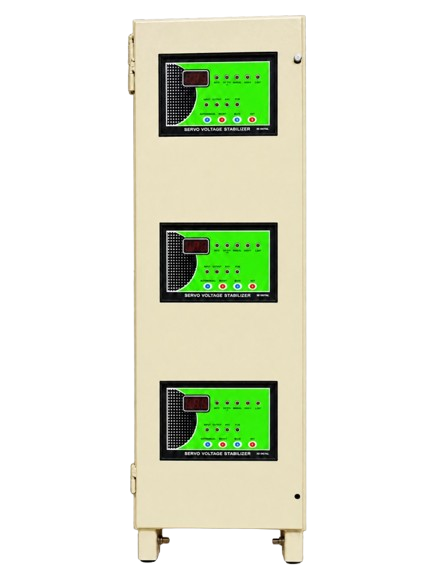
Available for single-phase and three-phase requirements.
Three-phase servo voltage stabilizers from 10–100 KVA for suitable industrial machines, production lines and commercial installations.
View details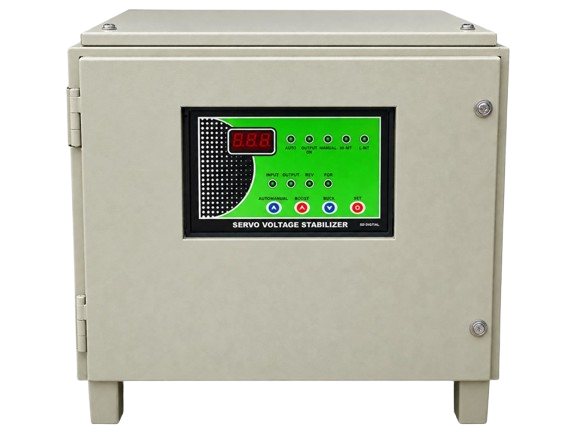
Single-phase servo voltage stabilizers from 1–60 KVA for suitable instruments, commercial equipment, workshop loads and residential requirements.
View detailsRolling Contact / Linear Type construction.
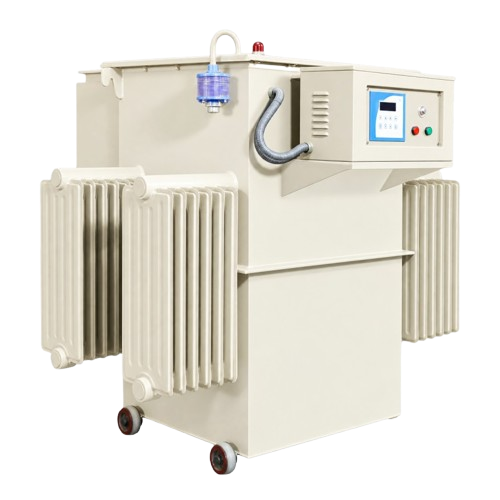
Specify the arrangement around the actual industrial load and supply.
View detailsStart with your load and site voltage. Then compare output, cooling, protections and the installation space the unit needs.
Compare cooling arrangementsReview the complete machine input, spindle and auxiliary loads, starting behavior and manufacturer supply tolerance.
Machine checklistReview pumps, compressors, RO, filling and packaging equipment together, including simultaneous starts.
Plant checklistList the equipment that runs together. Check supply phase, measured voltage, operating duty and future expansion.
Manufacturing checklistInclude drives, motors, heaters and control loads. Confirm the supply tolerance required by each machine.
Process checklistRecord compressor and fan electrical ratings, starting method and operating sequence before selecting KVA.
HVAC checklistCheck each instrument’s required supply conditions. Voltage regulation and backup power are separate requirements.
Equipment checklistStart with the electrical nameplate, supply phase, total simultaneous load and measured minimum and maximum voltage. Motors and compressors also need a starting-demand review. KEVOR can help shortlist a capacity from those details; KVA alone does not confirm suitability.
Yes. KEVOR reviews single-phase requirements up to 60 KVA and three-phase requirements up to 100 KVA. For higher capacities, we review the load and agree the construction through a technical quotation. Rolling-contact / linear requirements are reviewed separately as custom-made projects.
Air-cooled units dissipate heat through their air-cooling arrangement; oil-cooled designs use insulating oil as part of their thermal design. Choose from duty, ambient conditions, ventilation, service access and the actual model specification. A capacity number alone does not determine the right cooling method.
No. A servo stabilizer regulates available AC voltage within its specified operating range. It does not supply electricity during an outage. Backup requirements need a suitable UPS, inverter or generator arrangement.
The written quotation should confirm capacity, phase, input-voltage range, nominal output, cooling, protection options, price, freight, installation scope and order-specific warranty. Product dimensions and any performance figures should come from the selected configuration.
It keeps the voltage supplied to your equipment close to a chosen output level when the incoming mains voltage rises or falls within its correction range. This can help machines operate within their specified supply limits. It does not provide electricity during a power cut.
A stabilizer corrects sustained low or high supply voltage so a connected appliance receives a more suitable voltage. First check whether the appliance already accepts your measured supply range. A stabilizer cannot repair loose wiring, a faulty neutral or every kind of power disturbance.
Common applications include CNC machines, packaging lines, printing equipment, pumps, refrigeration, laboratories and commercial mainline supplies. The machine name alone is not enough to choose a unit: check its electrical load, starting current, phase and supply limits.
Voltage stabilizer is the broad product category. A servo voltage stabilizer is one type within it, using a motor-driven correction mechanism. Relay models switch between transformer taps, while static regulators use electronic correction.
Start with the maximum simultaneous electrical load. If you know real input power and power factor, KVA = kW ÷ power factor. For example, 10 kW at 0.8 power factor is 12.5 KVA before starting demand and any design margin. Motors, low input voltage and future loads need a separate review; do not select solely from this calculation.
A controller senses output voltage and compares it with the set value. It drives a servo motor to adjust a variable autotransformer; in a common design, a buck-boost transformer then adds or subtracts correction voltage. The motor stops when the output reaches the control band and adjusts again when needed.
Motor-driven adjustment takes time, and brushes, contacts and moving parts need inspection according to the model’s service schedule. The cabinet also needs suitable ventilation and space. Very rapid disturbances or a need for battery backup may call for other equipment.
Yes, when the input is low and remains inside the designed correction range, it can boost voltage. It also reduces high voltage. It does not create extra power: the input current can rise when supplying the same load from a lower voltage.
A servo design gives continuous motor-driven correction and is often chosen for industrial loads needing tighter regulation. Relay designs make stepped corrections and can be a practical choice for appliances. Compare the actual voltage tolerance, current rating, correction range and service support rather than choosing by technology alone.
It is a servo stabilizer whose controller adjusts voltage without manual intervention. The controller senses voltage and drives the correction motor as needed. Automatic does not mean unlimited correction: the unit still has a specified input range, load rating and protection settings.
Consider air cooling when the selected model can carry your load and the site provides the ventilation, ambient conditions and space it needs. Check its duty rating, ambient-temperature limit and installation clearances with KEVOR before choosing the construction.
Send your machine details on WhatsApp, or leave your number. We’ll help you take the next step.
Send a nameplatePrefer to talk? +91 76696 69400Just your name and number to get started.