1. Monitor
The control circuit monitors voltage and compares the measured output with the selected voltage setting.
Three-phase servo voltage stabilizers from 10–100 KVA for suitable industrial machines, production lines and commercial installations.
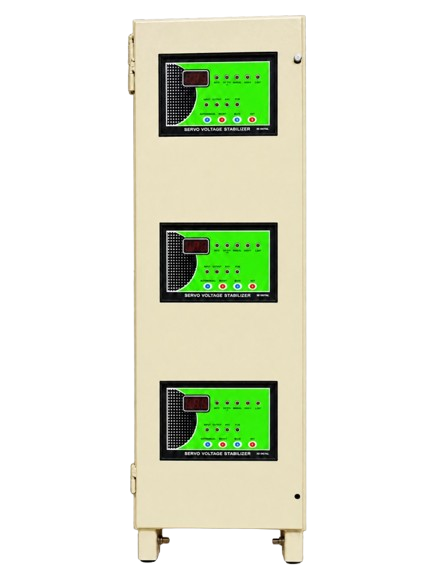
A three-phase servo voltage stabilizer monitors voltage changes and uses a motor-driven correction mechanism to keep the equipment supply close to the selected output level. It can raise low voltage or reduce high voltage within its specified correction range.
KEVOR’s three-phase range covers 10–100 KVA for suitable industrial and commercial requirements. Review the complete electrical load, measured site voltage, starting demand and the machine manufacturer’s supply limits before selection.
Voltage regulation uses the available mains supply. Backup power and electrical isolation are separate requirements.
The application is a starting point. The complete electrical input, start-up behavior, permissible supply voltage and installation determine suitability.
A servo stabilizer raises low voltage or reduces high voltage within its specified operating range.
The control circuit monitors voltage and compares the measured output with the selected voltage setting.
The servo motor moves the regulating mechanism to increase or decrease voltage correction.
Feedback continues as the supply changes. A large voltage correction takes mechanical movement; the controller’s reaction time and the complete correction time are different.
A conventional variac-based servo design uses a variable autotransformer, a buck-boost transformer and a servo motor. The regulating arrangement and component selection are confirmed for the offered model. Voltage regulation uses the available AC supply; battery backup and electrical isolation are separate functions.
The incoming voltage window for the selected configuration. Confirm whether full rated load is supported throughout that window.
The target voltage and permitted variation under stated conditions. The nominal value alone is not a guarantee of regulation accuracy.
The rate of voltage correction, normally expressed in volts per second. It varies with the selected construction.
A defined reaction interval. It should not be confused with the time needed to complete a large mechanical voltage correction.
Capacity must be considered with phase, voltage, simultaneous electrical load and motor starting demand. kW and KVA are not interchangeable.
Cut-offs, overload arrangements, phase monitoring and bypass are model-specific. Confirm the actual supplied features in the technical offer.
Air-cooled construction transfers heat to the surrounding air. Oil-cooled construction uses insulating oil in its thermal design. Cooling must suit the load, operating hours, ventilation and ambient conditions.
Voltage correction does not replace a frequency converter or harmonic filter. Check the permitted supply frequency and any distortion limits against the equipment requirements.
Continuous duty describes operation under specified conditions; it does not mean unlimited service life. Ambient temperature and temperature rise describe different measurements.
Efficiency depends on the operating conditions and load. Ask which input voltage and load were used for the stated figure. Regulation alone does not establish an electricity-saving percentage.
Three-phase selection needs the load and voltage on each phase. Confirm independent phase correction, neutral requirements and permitted imbalance for the offered design.
A standard number should identify the relevant product and test scope. Request the applicable model documents instead of treating a catalogue reference as certification.
A controller monitors voltage and operates a servo motor-driven correction mechanism to raise low voltage or reduce high voltage within the selected unit’s operating range.
KEVOR’s published three phase range is 10–100 KVA. Confirm the actual electrical input, simultaneous load and starting demand before choosing a capacity.
It regulates available supply within its specified operating limits. Backup, galvanic isolation, surge protection and wiring faults require their own assessment. Check the connected equipment manufacturer’s requirements.
Price depends on the agreed configuration and order scope. KEVOR offers Pan-India door delivery; the quotation confirms freight, dispatch, installation and warranty arrangements.
Send your machine details on WhatsApp, or leave your number. We’ll help you take the next step.
Send a nameplatePrefer to talk? +91 76696 69400Just your name and number to get started.